

Table of Contents
ToggleAnyone who’s wrestled with a circular saw halfway through a cut, watching their “straight” line wander into a drunken curve, knows the frustration. The tool’s powerful enough, the blade’s sharp, but without a guide, keeping that cut true is harder than it looks. A circular saw guide isn’t some optional accessory for perfectionists. It’s the difference between ripping plywood panels that fit flush or spending an hour with a belt sander trying to fix wavy edges. Whether building cabinets, framing walls, or breaking down sheet goods, a good guide turns a versatile power tool into a precision instrument.
Key Takeaways
- A circular saw guide eliminates lateral drift and blade deflection, transforming a powerful tool into a precision instrument for cabinet work, framing, and sheet goods breakdown without costly rework.
- Circular saw guides come in three main types—factory rip fences (adequate for rough work), straightedge guides ($50–$100, versatile for DIYers), and track systems ($300+, ideal for finish carpentry and frequent professional work).
- You can build a DIY circular saw guide from basic materials like MDF and hardboard for under $20 in under an hour, with accuracy that rivals commercial guides by having the saw cut its own reference edge.
- Proper technique with a circular saw guide includes secure clamping, accounting for base plate offset, maintaining even pressure, and using sharp, material-appropriate blades to achieve clean, repeatable cuts.
- Straightedge guides are the most versatile option for sheet goods and panel work, offering material savings and accuracy that justifies the investment for plywood, MDF, and melamine projects.
- Always support workpieces on both sides of the cut and prioritize safety with appropriate PPE, secure clamping, and proper technique to prevent binding, kickback, and achieve professional-grade results.
What Is a Circular Saw Guide and Why Do You Need One?
A circular saw guide is any device or system that keeps the saw’s base plate moving along a fixed path during a cut. It can be as simple as a clamped straightedge or as sophisticated as an aluminum track with anti-slip strips and dust extraction. The goal’s the same: eliminate lateral drift so the blade cuts exactly where intended.
Without a guide, saw operators rely on visual alignment with a pencil line, which sounds straightforward until the blade enters the material. Saw torque, blade deflection, binding, and simple hand wobble all conspire to push the cut off-line. Even experienced carpenters can drift 1/8 inch or more on a four-foot rip, which is unacceptable for joinery, trim work, or any application where edges mate.
Guides solve three core problems:
- Repeatability: Cut identical widths across multiple boards without re-measuring every pass.
- Safety: A stabilized saw is less likely to bind, kickback, or skate across the workpiece.
- Material efficiency: Straight cuts mean less waste and fewer ruined panels, especially on expensive hardwood plywoods or sheet goods.
For anyone cutting more than the occasional 2×4, a guide isn’t optional, it’s foundational. The return on investment shows up the first time a sheet of three-quarter-inch birch plywood yields eight perfect shelves instead of seven good ones and a firewood offcut.
Types of Circular Saw Guides for Different Projects
Guides come in several formats, each suited to different tasks, budgets, and workshop setups. Choosing the right type depends on the kind of cuts being made and how often precision matters.
Edge Guides and Rip Fences
Most circular saws ship with a basic rip fence, a stamped-metal or plastic attachment that rides along the edge of the workpiece. It’s adjustable, usually spanning cuts up to about 8 inches, and works fine for rough framing or ripping dimensional lumber to width.
Limitations show up fast, though. The fence relies on the board edge being perfectly straight, which isn’t guaranteed on job-site lumber or salvaged stock. The narrow contact area also makes it easy to tilt the saw if pressure isn’t evenly applied. For breaking down plywood or making cabinet-grade cuts, factory rip fences are marginal at best.
Aftermarket edge guides improve on this. Models with wider bases, longer rods, and micro-adjustment screws offer better stability and finer control. They’re still edge-referencing, so workpiece straightness matters, but build quality is a step up from stock accessories. Expect to pay $30 to $60 for a decent aftermarket guide that fits most seven-and-a-quarter-inch saws.
Track Saw Systems and Straightedge Guides
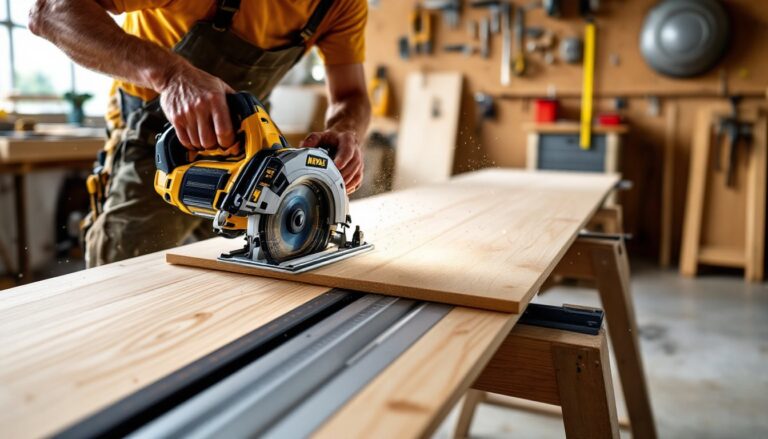
Track saw systems represent the premium end. These pair a specialized circular saw with an extruded aluminum track featuring rubber or foam anti-slip strips on the underside. The saw’s base plate has grooves or bearings that lock into the track, creating a guided rail system similar to a panel saw. The benefit’s obvious: dead-straight cuts up to eight feet or longer, with zero drift and splinter-free edges if the track includes a zero-clearance strip.
Brands like Festool, Makita, and DeWalt offer complete systems starting around $300 and climbing past $600 for professional kits. That’s a significant investment, but for contractors doing kitchens, built-ins, or finish carpentry, the speed and accuracy often justify the cost. Track saws excel at breaking down full sheets into manageable pieces without needing a table saw.
For DIYers not ready to spend that much, a straightedge guide offers a middle path. These are simple aluminum or steel rails, typically four to eight feet long, clamped to the workpiece. The saw’s base plate rides against the edge. Quality examples from manufacturers like Kreg or Bora include measuring scales, non-slip pads, and repeatable offset markings so users can align the guide to the cut line accounting for the saw’s base width. A good straightedge guide runs $50 to $100 and works with any circular saw, making it the most versatile option for weekend warriors.
How to Choose the Right Circular Saw Guide for Your Needs
Picking the right guide starts with honest assessment: What kind of cuts happen most often, and how much precision do they require?
For occasional rip cuts on framing lumber or deck boards, the factory rip fence is adequate. It’s already on the saw, costs nothing, and handles rough work where 1/16-inch variance doesn’t matter. If upgrading, an aftermarket edge guide is a modest expense that improves consistency.
For breaking down sheet goods (plywood, MDF, melamine), a straightedge guide or track system is essential. These materials are expensive, and mistakes are costly. A four-foot or eight-foot straightedge guide handles most panel work and stores easily. If budget allows and the work is frequent, a track saw system pays for itself in material savings and time efficiency.
For finish carpentry, cabinetry, or projects requiring tight tolerances, invest in a track system or build a high-quality DIY guide (covered next). The zero-clearance edge and anti-chip performance of a proper track guide keeps veneer plywoods looking clean and eliminates the need for edge-banding or sanding to hide tearout.
Material compatibility also matters. Guides with rubber strips work well on most surfaces but can leave marks on pre-finished panels. Foam strips are gentler but wear faster. Clamp-based straightedges work anywhere but require flat surfaces for secure attachment.
Finally, consider portability and storage. Jobsite contractors need guides that break down or nest for transport. Home shop users can opt for longer, heavier guides that stay put during cuts. Match the tool to the workflow, not the marketing.
DIY Circular Saw Guide: Build Your Own for Under $20
Building a shop-made circular saw guide is one of the highest-return projects a DIYer can tackle. Materials cost less than $20, construction takes under an hour, and the result rivals commercial guides for accuracy.
Materials needed:
- One half-sheet (4×4 feet) of 1/2-inch MDF or plywood
- One eight-foot piece of 1/4-inch hardboard (Masonite), ripped to 10 inches wide
- Wood glue
- Four to six 1-inch screws or brads
- Sandpaper (120-grit)
Tools required:
- Circular saw (the one being guided)
- Straightedge or factory rip fence for initial cuts
- Drill or brad nailer
- Clamps
Step-by-step construction:
- Cut the base: Rip the MDF or plywood into an eight-foot strip, 10 inches wide. This becomes the reference base. Accuracy here doesn’t matter yet, just get it close.
- Cut the fence: Rip the hardboard to about 4 inches wide and eight feet long. This strip will be the fence the saw rides against.
- Attach the fence: Glue and fasten the hardboard strip along one edge of the MDF base, flush with the edge. Let the glue dry for 20 minutes.
- Trim the base to final width: Clamp the guide to a work surface. Set the circular saw’s base plate against the hardboard fence and run the saw down the full length of the guide, trimming the MDF base. The cut edge is now perfectly parallel to the fence, offset exactly by the saw’s base width.
- Mark the offset: Measure from the fence to the trimmed edge and write that dimension on the fence. This is the guide’s offset. When aligning cuts, measure from the cut line and place the trimmed edge on that mark.
This design works because the same saw that uses the guide also cuts it to size, automatically compensating for base plate width. Many woodworking enthusiasts build multiple guides in four-foot and eight-foot lengths for different tasks. Total cost: about $15 if buying a half-sheet of MDF and a piece of hardboard.
Optional upgrades: Add a strip of 120-grit adhesive sandpaper to the underside of the base to prevent slipping, or attach a measuring tape along the fence for quick layout. Some builders add handles or T-track for hold-down clamps.
Tips for Using Circular Saw Guides Like a Pro
Even the best guide won’t deliver clean cuts if technique’s off. A few practiced habits separate amateur results from pro-grade work.
Clamp the guide securely. Whether using a commercial straightedge or DIY version, two clamps minimum, one near each end, keep the guide from shifting mid-cut. On long cuts, add a third clamp at the center. Bar clamps or quick-grip clamps work best: spring clamps lack the holding power for this application.
Account for offset correctly. If using a straightedge guide without offset markings, measure from the blade to the edge of the saw’s base plate. Mark that distance from the cut line and align the guide’s edge to the mark. Double-check before cutting. A 1/8-inch mistake on a 48-inch rip means a ruined panel.
Start the saw before entering the cut. Let the blade reach full speed, then ease it into the material with steady, even pressure. Rushing the entry invites kickback or blade deflection. On thick stock like two-by lumber, let the saw do the work, forcing it burns the blade and wanders the cut.
Maintain consistent pressure against the guide. The saw should ride the fence or track with light, steady contact throughout the cut. Pushing too hard can bow a flexible guide or tilt the saw: too little and the blade drifts. Practice on scrap until muscle memory takes over.
Use a sharp blade appropriate to the material. A dull framing blade will tear plywood veneer no matter how good the guide. For sheet goods, use a 40-tooth to 60-tooth carbide blade designed for crosscuts or plywood. Replace or sharpen blades when they start burning wood or leaving rough edges.
Wear appropriate PPE. Safety glasses are non-negotiable, circular saws throw chips fast and hard. Hearing protection is smart for extended use: saws peak around 100 decibels. If cutting treated lumber, MDF, or any material producing fine dust, add a dust mask or respirator. Many track systems include dust collection ports that connect to shop vacuums, drastically reducing airborne particles.
Support the workpiece properly. Plywood or long boards need support on both sides of the cut to prevent binding or the offcut from falling and pinching the blade. Use sawhorses, a workbench, or sacrificial foam insulation sheets on the floor. Never let the offcut hang unsupported, that’s a recipe for kickback.
Check the guide for wear. On DIY guides, the hardboard fence edge can develop grooves or dings over time. Inspect it periodically and replace the fence strip if accuracy degrades. Commercial track systems should have their rubber or foam strips checked for compression or tearing.
Mastering these habits transforms a circular saw from a rough-carpentry tool into a precision instrument capable of joinery-grade work. The guide provides the mechanism: technique delivers the results.